Abstract
Background: Levofloxacin (LVFX) is widely used for many respiratory, urinary, and oral infections. Although rare, tendinopathy and tendon rupture have been reported in patients treated with LVFX as adverse effect. However, the exact mechanism is not fully elucidated. In this study, we investigated the effects of LVFX on tendon cells and tendon tissue. Method: Murine tendon cell line TT-D6 cells were treated with LVFX. Total RNA was extracted from the treated cells and quantitative reverse-transcription polymerase chain reaction (RT-PCR). LVFX-treated TT-D6 cells were subjected to cell proliferation assays and reactive oxygen species production assays. In addition, LVFX was administered to rats, and total RNA was extracted from tendon tissue and quantitatively analyzed for mRNA expression using quantitative RT-PCR. Results: Proliferative capacity in TT-D6 cells treated with various concentrations of LVFX showed no significant differences in any of the group comparisons. Quantitative RT-PCR analysis in TT-D6 cells showed that collagen 12a1 (COL12A1) expression was significantly decreased in the LVFX-treated group compared with the control group. The expression of matrix metalloproteinase-2 and tissue inhibitor of metalloproteinase-2 was significantly increased in the LVFX group. On the other hand, there were no significant differences in mRNA expression of decorin, matrix metalloproteinase-9, and Collagen1a1. ROS production was significantly upregulated in LVFX-treated rats, and COL12A1 expression was significantly decreased in LVFX-treated rats compared with controls in tendons collected from LVFX-treated rat models. Conclusions: Taken together, COL12A1 reduction may be involved in tendon injury and tendon rupture in LVFX administration, suggesting that increased ROS production may be involved.
Keywords
Levofloxacin, Adverse Effect, Tendon, Type XII Collagen, Reactive Oxygen Species
1. Introduction
Levofloxacin (LVFX) belongs to the fluoroquinolones (FQs) class of antibiotics that directly inhibits bacterial DNA synthesis. LVFX is widely used for respiratory tract infections, urinary tract infections, and skin infections, and is also frequently used in the oral and maxillofacial region due to its broad antibacterial spectrum, excellent antibacterial activity, and safety
| [1] | Baik S, Lau J, Huser V, McDonald CJ. Association between tendon ruptures and use of fluoroquinolone, and other oral antibiotics: a 10-year retrospective study of 1 million US senior Medicare beneficiaries. BMJ Open 2020; 10: e034844. https://doi.org/10.1136/bmjopen-2019-034844 |
| [2] | Asoda S, Iwasaki R, Fukaya C, Hosaka Y, Usuda S, Kawana H, et al. Oral and maxillofacial tissue penetration of levofloxacin following oral administration of a single 500 mg dose. Jpn J Chemother 2012; 60: 643-5. |
[1, 2]
. While seizures, arrhythmia, and hypoglycemia have been reported as major adverse effects of FQs, tendon disorders such as tendon rupture have been reported to occur as a rare adverse effect of FQs
| [3] | Shu Y, Zhang Q, He X, Liu Y, Wu P, Chen L. Fluoroquinolone-associated suspected tendonitis and tendon rupture: A pharmacovigilance analysis from 2016 to 2021 based on the FAERS database. Front Pharmacol 2022; 13: 990241. https://doi.org/10.3389/fphar.2022.990241 |
[3]
. FQs-related tendonitis and tendon ruptures tend to occur within one month, whereas LVFX-induced tendon ruptures having an onset time of three days
| [3] | Shu Y, Zhang Q, He X, Liu Y, Wu P, Chen L. Fluoroquinolone-associated suspected tendonitis and tendon rupture: A pharmacovigilance analysis from 2016 to 2021 based on the FAERS database. Front Pharmacol 2022; 13: 990241. https://doi.org/10.3389/fphar.2022.990241 |
[3]
.
Tendons, which exist between bone and muscle as anatomically non-contractile elements, are divided into attachment and intermediate parts. The middle part is composed of collagen, proteoglycans, and glycoproteins, with collagen type I making up the majority, but collagen types III, IV, V, VI, XII, and XIV are also included
| [4] | Riley G. Tendinopathy-from basic science to treatment. Nat Clin Pract Rheumatol 2008; 4: 82-9. |
[4]
. Expression of type XII collagen found in the search for collagen sequences from chick tendon fibroblasts is unevenly distributed in mesenchymal tissues containing type I collagen during embryonic development, and its distribution is located in tendon, bone, and periodontal tissues in a restricted manner postnatally
| [5] | Gordon MK, Gerecke DR, Olsen BR. Type XII collagen: distinct extracellular matrix component discovered by cDNA cloning. Proc Natl Acad Sci U S A 1987; 84: 6040-4. https://doi.org/10.1073/pnas.84.17.6040 |
| [6] | Böhme K, Li Y, Oh PS, Olsen BR. Primary structure of the long and short splice variants of mouse collagen XII and their tissue-specific expression during embryonic development. Dev Dyn 1995; 204: 432-45. https://doi.org/10.1002/aja.1002040409 |
| [7] | Karimbux NY, Nishimura I. Temporal and spatial expressions of type XII collagen in the remodeling periodontal ligament during experimental tooth movement. J Dent Res 1995; 74: 313-8. https://doi.org/10.1177/00220345950740010501 |
[5-7]
. Type XII collagen forms cross-bridges of collagen I-containing fibers through its collagen domain in complex with tenascin X and decorin
. In addition, type XII collagen is involved in the formation of networks between tendon cells and in the development and growth of tendon tissue, and the cross-linking of type XII collagen in tendons plays a vital role in the mechanical properties of tendons
.
Achilles tendon disorders associated with the administration of FQs have been reported with an Achilles tendon rupture rate of 1 in 5,958 patients treated with FQs and a tendon rupture rate of 1.2 per 10,000 patients treated with FQs
. In addition, when Magnetic Resonance Imaging (MRI) was performed on a patient with suspected tendinitis due to FQs, a partial rupture of the Achilles tendon was identified approximately 4 cm above the calcaneal insertion site
. On the other hand, tendon damage caused by administration of FQs is not specific to the Achilles tendon, but has also been observed in the long head of the biceps brachii, extensor digitorum longus, and supraspinatus muscles. The Achilles tendon is particularly vulnerable to damage because it plays a weight-bearing role
| [13] | Kowatari K, Nakashima K, Ono A, Yoshihara M, Amano M, Toh S. Levofloxacin-induced bilateral Achilles tendon rupture: a case report and review of the literature. J Orthop Sci 2004; 9: 186-90. https://doi.org/10.1007/s00776-003-0761-4 |
[13]
.
Tendons are exposed to reactive oxygen species (ROS) generated from surrounding tissues during exercise, which inhibits repair and other functions. Tendon rupture is thought to be caused by the degree of adaptive response to ROS exposure, including intense exercise and genetic factors
. Pouzaud et al. demonstrated that FQs showed moderate cytotoxicity on spontaneously immortalized rabbit tendon cell line, suggesting early oxidative stress in the development of fluoroquinolone-induced tendinopathy
| [16] | Pouzaud F, Bernard-Beaubois K, Thevenin M, Warnet JM, Hayem G, Rat P. In vitro discrimination of fluoroquinolones toxicity on tendon cells: involvement of oxidative stress. J Pharmacol Exp Ther 2004; 308: 394-402. https://doi.org/10.1124/jpet.103.057984 |
[16]
. Tendon disorders caused by FQs are more likely to occur in patients at high risk, such as the elderly and those on concomitant corticosteroids, because of the low metabolic rate and poor healing response in mature tendon tissue
. However, the mechanism of tendon damage caused by LVFX is not fully elucidated.
We hypothesize that the cause of LVFX-induced tendon damage is related to a decrease in type XII collagen. In this study, we examined changes in gene expression such as type XII collagen and the evaluation of ROS production in murine tendon cells treated with LVFX. We also examined changes in type XII collagen gene expression in tendon tissue from rats treated with LVFX.
2. Materials and Methods
2.1. Cell Culture and Reagent
We used murine tendon cells, TT-D6 cell line, which were cultured in
-minimum Eagle’s medium (WAKO, Osaka, Japan) supplemented with 1% penicillin/streptomycin and 10% fetal bovine serum, at 33°C in a 5% CO
2 atmosphere
| [18] | Salingcarnboriboon R, Yoshitake H, Tsuji K, Obinata M, Amagasa T, Nifuji A, et al. Establishment of tendon-derived cell lines exhibiting pluripotent mesenchymal stem cell-like property. Exp Cell Res 2003; 287: 289-300. https://doi.org/10.1016/s0014-4827(03)00107-1 |
[18]
. We used levofloxacin (LVFX, Tokyo Kasei Kogyo, Tokyo, Japan).
2.2. Cell Proliferation Assay
Cells were seeded onto 96-well plates at 1 × 10⁴ cells per well and incubated for 72 h with LVFX (0, 1.6, 3.1, 6.3, 12.5, 25, 50, 100 g/mL). To estimate cell proliferation, we used the Cell Titer 96 Aqueous One Solution Cell Proliferation Assay (Promega, Fitchburg, Wisconsin, USA), according to the manufacturer’s instructions. Six replicate-measurements were made.
2.3. Quantitative Reverse-transcription Polymerase Chain Reaction (qRT-PCR)
Cells were seeded onto 6-well plates at 30 × 10⁴ cells per well. LVFX was immediately added to the plates at concentrations of 0, 10, and 100 mg/mL
, and the cells were collected 72 h later. The harvested cells were rinsed with ice-cold phosphate-buffered saline (PBS). QIAzol Lysis Reagent (QIAGEN, Hilden, Germany) was added to the samples, and the total RNA was extracted. The purity of the RNA was checked using Nanodrop 2000 (Thermo Fisher Scientific, Waltham, MA, USA).
The reverse-transcription reaction was performed with a High Capacity cDNA Reverse Transcription kit (Thermo Scientific). qPCR was conducted by TaqMan-based detection using THUNDERBIRD probe qPCR Mix (Toyobo, Osaka, Japan). TaqMan Gene Expression Assays (Thermo Scientific) used in this study are listed in
Table 1. We performed reactions at 95°C for 20 sec, followed by 40 cycles of 95°C for 1 sec, and 60°C for 20 sec with Step One Plus Real-Time PCR System (Thermo Scientific). All experiments were performed in quadruplicate, i.e., each reaction was performed in quadruplicate on four individual samples. Values were normalized to those of glyceraldehyde-3-phosphate dehydrogenase using the 2
-DDCt method. This experiment was repeated at least three times.
2.4. Creation of LVFX-administered Rat Models, Sample Collection and RNA Extraction
Five-week-old male Wistar rats (200 to 300 g in weight) were obtained from Japan SLC (Shizuoka, Japan). LVFX concentrations were based on Bidell et al
| [20] | Bidell MR, Lodise TP. Fluoroquinolone-Associated Tendinopathy: Does Levofloxacin Pose the Greatest Risk? Pharmacotherapy 2016; 36: 679-93. https://doi.org/10.1002/phar.1761 |
[20]
. Rats were weighed and injected with a dose of 300 mg of LVFX per kg of body weight, 200 mL each in the bilateral anterior and posterior limbs and the abdominal cavity, for a total of 1 mL. This is equivalent to a human concentration of 500 mg per 24 h. The control group received the same amount of Phosphate Buffered Saline (PBS) used as a solvent at the same site. The LVFX-treated model rats served as the treatment group, and the PBS-treated rats served as the control group. Anesthesia was performed by placing a cotton ball containing 2% sevoflurane (Nikko Pharmaceutical, Shizuoka, Japan) as an inhalation anesthetic in the bottom of an anesthesia bottle, placing a wire mesh over the cotton ball, placing a rat on the mesh, and covering the mesh with a lid. Under anesthesia, LVFX was administered into both anterior and posterior limbs and abdominal cavity of rats using a tuberculin syringe (Terumo, Tokyo, Japan). The administration period was 7 days for both the treatment and control groups. On the day following the final administration, the rats were euthanized by inhalation of an excess of sevoflurane. Four rats were used in each experimental group. This experiment has been approved by the University's Animal Experiment Committee (Approval No. 3812). In the euthanized LVFX-treated rat model, tendon specimens were collected separately from the forelimb and hindlimb using a No. 15 shear (Feather Safety Razor, Osaka, Japan). QIAzol Lysis Reagent (Qiagen, Hilden, Germany), 1 mL, was added to the specimens and homogenized using Biomasher II. After homogenization, the supernatant obtained by centrifugation was subjected to RNA extraction according to the protocol of the Fast Gene RNA Basic Kit (Nippon Genetics, Tokyo, Japan).
2.5. Reactive Oxygen Species (ROS) Measurement
Cells were seeded onto 96-well plates at 1 × 10⁴ cells per well and incubated for 72 h with LVFX (0, 10, 100 mg/mL). To measure ROS, the medium was collected and replaced with PBS containing CM-H2DCFDA (C6827, Thermo Fisher Scientific) at a concentration of 5 mM and incubated for 30 min. 2',7'-Dichlorodihydrofluorescin diacetate (DCF) oxidized by ROS was measured using Varioskan flash (Thermo Fisher Scientific) at excitation and fluorescence wavelengths of 485 nm and 535 nm, respectively. Six replicate-measurements were made.
2.6. Statistical Analysis
Comparisons between two groups were analyzed using Student’s t-tests, and comparisons among three groups were analyzed using one-way analysis of variance (ANOVA) and Bonferroni–Dunn methods (statistical significance at p < 0.05). All values are presented as the mean ± S.E.M. Results are representative examples of more than three independent sets of experiments.
Table 1. The list of TaqMan Gene Expression Assays.
Gene name | Assay ID |
Mouse Primer | |
COL1A1 (Collagen1a1) | Mm00801666_g1 |
COL12A1 (Collagen12a1) | Mm01148576_m1 |
DCN (Decorin) | Mm00514535_m1 |
MMP-2 | Mm00439498_m1 |
MMP-9 | Mm00442991_m1 |
TIMP-2 | Mm00441823_m1 |
ACTB (Beta Actin) | Mm02619580_g1 |
Rat Primer | |
COL12A1 (Collagen12a1) | Rn01521220_m1 |
GAPDH | Rn01775763_g1 |
MMP-2: Matrix metalloproteinase-2, MMP-9: Matrix. metalloproteinase-9, TIMP-2: Tissue inhibitor of metalloproteinase-2, GAPDH: Glyceraldehyde-3-phosphate dehydrogenase
3. Results
3.1. LVFX Does Not Inhibit Cell Proliferation in TT-D6 Cells
First, we examined whether LVFX treatment causes changes in cell proliferative capacity in TT-D6 cells. No significant differences were observed in the treatment group compared to the control group (
Figure 1).
3.2. LVFX Inhibits Gene Expression of Type XII Collagen in TT-D6 Cells
We focused on type XII collagen (COL12A1) because it is involved in the formation of networks between tendon cells and in the development and growth of tendon tissue
. Expectdly, mRNA expression of COL12A1 was decreased in LVFX-treated TT-D6 cells (
Figure 2).
3.3. LVFX Upregulates Gene Expression of Both MMP-2 and TIMP-2 in TT-D6 Cells
Tsai et al. demonstrated that ciprofloxacin which is an antibiotic agent in the fluoroquinolone class modulates the expression of matrix metalloproteinases (MMPs), tissue inhibitors of metalloproteinase (TIMPs) and type I collagen (COL1A1) in primary Achilles tendon cells
| [21] | Tsai WC, Hsu CC, Chen CP, Chang HN, Wong AM, Lin MS. Ciprofloxacin up-regulates tendon cells to express matrix metalloproteinase-2 with degradation of type I collagen. J Orthop Res 2011; 29: 67-73. https://doi.org/10.1002/jor.21196 |
[21]
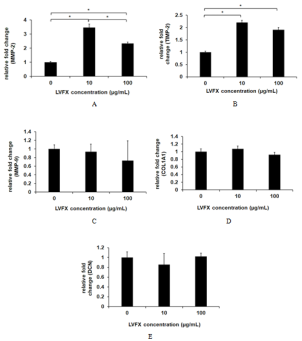
. In reference to this report, we investigated whether LVFX affects the expression of COL1A1, MMPs, and TIMPs in TT-D6 cells. Both MMP-2 and TIMP-2 mRNA expression is upregulated in LVFX-treated cells compared to the control (
Figure 3A and 3B), whereas no significant differences in gene expression of MMP-9 and COL1A1 were observed between the control and LVFX-treated cells (
Figure 3C and 3D). As collagen XII interacts with decorin (DCN)
, we examined DCN expression in LVFX-treated TT-D6 cells. Unexpectedly, no change in DCN gene expression between the control and LVFX-treated cells (
Figure 3E).
3.4. COL12A1 Gene Expression in Tendon Tissue Is Decreased in LVFX-Treated Rat Models
Total RNA was extracted from tendon tissue collected from LVFX-treated rat models, and the expression of COL12A1 was quantitatively evaluated by qRT-PCR. As expected, the expression of COL12A1 was significantly decreased in LVFX-treated rats compared with PBS-treated rats, the control group (
Figure 4).
3.5. LVFX Promotes ROS Production in TT-D6 Cells
Considering the possibility that overproduction of ROS may be toxic to the extracellular matrix, we examined changes in ROS production upon LVFX treatment in TT-D6 cells. In LVFX-treated cells, DCF oxidized and generated by ROS was significantly increased compared to the control (
Figure 5).
Figure 1. No effect of levofloxacin on cell proliferation.
Effect of LVFX (0, 1.6, 3.1, 6.3, 12.5, 25, 50, 100 µg/mL) on. proliferation of TT-D6 cells incubated for 3 days. Data are expressed as mean ± S.E.M. *p < 0.05.
Figure 2. Inhibition of COL12A1 expression in LVFX-treated tendon cell line.
Expression of COL12A1 mRNA in TT-D6 cells treated with. LVFX (10, 100 µg/mL) for 72 h estimated by quantitative RT-PCR analysis. Data are expressed as mean ± S.E.M. *p < 0.05.
Figure 3. Upregulation of MMP-2 and TIMP-2 in LVFX-treated. tendon cell line.
A) Expression of MMP-2 mRNA in TT-D6 cells treated with LVFX (10, 100 µg/mL) for 72 h estimated by quantitative RT-PCR analysis. B) Expression of TIMP-2 mRNA in TT-D6 cells treated with LVFX (10, 100 µg/mL) for 72 h estimated by quantitative RT-PCR analysis. C) Expression of MMP-9 mRNA in TT-D6 cells treated with LVFX (10, 100 µg/mL) for 72 h estimated by quantitative RT-PCR analysis. D) Expression of COL1A1 mRNA in TT-D6 cells treated with LVFX (10, 100 µg/mL) for 72 h estimated by quantitative RT-PCR analysis. E) Expression of DCN mRNA in TT-D6 cells treated with LVFX (10, 100 µg/mL) for 72 h estimated by quantitative RT-PCR analysis. Data are expressed as mean ± S.E.M. *p < 0.05.
Figure 4. Inhibition of COL12A1 expression in LVFX-treated. tendon tissue.
Expression of COL12A1 mRNA in bilateral anterior and posterior. limbs and the abdominal cavity of rats (N=4) which are administered to LVFX estimated by quantitative RT-PCR analysis. Data are expressed as mean ± S.E.M. *p < 0.05.
Figure 5. Promotion of ROS production in LVFX-treated tendon. cell line.
Effect of LVFX (10, 100 µg/mL) on ROS production of TT-D6 cells incubated for 3 days. Data are expressed as mean ± S.E.M. *p < 0.05.
4. Discussion
Type XII collagen is involved in intercellular communication and mechanical properties by forming collagen cross-links between adjacent cells during tissue development and growth
| [8] | Chiquet M, Birk DE, Bönnemann CG, Koch M. Collagen XII: Protecting bone nd muscle integrity by organizing collagen fibrils. Int J Biochem Cell Biol 2014; 53: 51-4. https://doi.org/10.1016/j.biocel.2014.04.020 |
| [22] | Nishiyama T, McDonough AM, Bruns RR, Burgeson RE. Type XII and XIV collagens mediate interactions between banded collagen fibers in vitro and may modulate extracellular matrix deformability. J Biol Chem 1994; 269: 28193-9. |
[8, 22]
. The study by Izu et al. showed that fibrous collagen I was reduced in XII-deficient tendon cells compared to controls, suggesting that collagen XII signaling specifically alters tendon cell biogenesis
| [23] | Izu Y, Adams SM, Connizzo BK, Beason DP, Soslowsky LJ, Koch M, et al. Collagen XII mediated cellular and extracellular mechanisms regulate establishment of tendon structure and function. Matrix Biol 2021; 95: 52-67. https://doi.org/10.1016/j.matbio.2020.10.004 |
[23]
. In COL12A1-deficient mice, changes in the columnar structure of fibers in the long axis direction, disruption of tendon cell-to-cell communication and cell adhesion are observed, with gait abnormalities and rupture of the anterior cruciate ligament as the phenotype
| [23] | Izu Y, Adams SM, Connizzo BK, Beason DP, Soslowsky LJ, Koch M, et al. Collagen XII mediated cellular and extracellular mechanisms regulate establishment of tendon structure and function. Matrix Biol 2021; 95: 52-67. https://doi.org/10.1016/j.matbio.2020.10.004 |
| [24] | Fukusato S, Nagao M, Fujihara K, Yoneda T, Arai K, Koch M, et al. Collagen XII Deficiency Increases the Risk of Anterior Cruciate Ligament Injury in Mice. J Clin Med 2021; 10: 4051. https://doi.org/10.3390/jcm10184051 |
[23, 24]
. The expression of type XII collagen in Achilles tendon and anterior cruciate ligament was decreased in 17-week-old mice, although there was no significant difference between 4-week-old and 17-week-old mice
| [23] | Izu Y, Adams SM, Connizzo BK, Beason DP, Soslowsky LJ, Koch M, et al. Collagen XII mediated cellular and extracellular mechanisms regulate establishment of tendon structure and function. Matrix Biol 2021; 95: 52-67. https://doi.org/10.1016/j.matbio.2020.10.004 |
[23]
. Thus, type XII collagen is important for the acquisition of tendon function and mechanical properties, and suppression of type XII collagen expression may cause tendon disorders. Our study showed that LVFX had no effect on the proliferative potential of tendon cells, COL12A1 was decreased, and COL12A1 expression was also decreased in tendon tissue from LVFX-treated rats. In other words, our results suggest that LVFX may cause tendinopathy by inducing a decrease in COL12A1 in tendons. Type XII collagen binds to type I collagen via DCN
, but our results showed no significant difference in DCN expression after LVFX administration. Tendon damage caused by LVFX may be related to a decrease in type XII collagen independently of DCN.
Overproduction of ROS directly affects the extracellular matrix
| [16] | Pouzaud F, Bernard-Beaubois K, Thevenin M, Warnet JM, Hayem G, Rat P. In vitro discrimination of fluoroquinolones toxicity on tendon cells: involvement of oxidative stress. J Pharmacol Exp Ther 2004; 308: 394-402. https://doi.org/10.1124/jpet.103.057984 |
[16]
. In the present study, our results showed no significant difference between the control group and the low concentration group (LVFX10), but the high concentration group (LVFX100) significantly increased ROS production suggesting that the production of ROS may have decreased the expression of COL12A1. On the other hand, Zhang et al. reported that ROS generated via mitochondria may cause tendon dysfunction
| [24] | Fukusato S, Nagao M, Fujihara K, Yoneda T, Arai K, Koch M, et al. Collagen XII Deficiency Increases the Risk of Anterior Cruciate Ligament Injury in Mice. J Clin Med 2021; 10: 4051. https://doi.org/10.3390/jcm10184051 |
[24]
, and further studies on the pathway of ROS generation and the mechanism of action of ROS on type XII collagen are needed.
Tsai et al. treated primary cultures of rat tendon tissue with Ciprofloxacin and reported that MMP-2 was upregulated, COL1A1 was decreased, and TIMP-2 expression was unchanged
| [21] | Tsai WC, Hsu CC, Chen CP, Chang HN, Wong AM, Lin MS. Ciprofloxacin up-regulates tendon cells to express matrix metalloproteinase-2 with degradation of type I collagen. J Orthop Res 2011; 29: 67-73. https://doi.org/10.1002/jor.21196 |
[21]
. Our results agreed that MMP-2 was elevated and MMP-9 was unchanged, but TIMP-2 was elevated and COL1A1 was unchanged, which was not consistent with the results of Tsai et al. In the experiments of Tsai et al. used heterogeneous primary cultured cells from rat tendon tissue, whereas we used a homogeneous mouse tendon cell line, TT-D6 cells, which may have caused the inclusion of cells derived from peritendinous tissue in the experiments of Tsai et al. The difference in results may be due to the inclusion of cells derived from peritendinous tissues in their experiments. Pouzaud et al. reported that the tendon toxicity of FQs varied depending on their type
| [16] | Pouzaud F, Bernard-Beaubois K, Thevenin M, Warnet JM, Hayem G, Rat P. In vitro discrimination of fluoroquinolones toxicity on tendon cells: involvement of oxidative stress. J Pharmacol Exp Ther 2004; 308: 394-402. https://doi.org/10.1124/jpet.103.057984 |
[16]
, and it is possible that differences in results may have been caused by differences in the drugs used. Karousou et al. speculated that the elevated gene expression of TIMPs in ruptured tendon tissue may be a tissue response to overproduction of MMPs
| [25] | Karousou E, Ronga M, Vigetti D, Passi A, Maffulli N. Collagens, proteoglycans, MMP-2, MMP-9 and TIMPs in human achilles tendon rupture. Clin Orthop Relat Res 2008; 466: 1577-82. https://doi.org/10.1007/s11999-008-0255-y |
[25]
. The local balance between MMPs and TIMPs is important for the maintenance of the extracellular matrix of tendons, and the resulting changes in collagen synthesis and degradation may affect tendons. Our experiments suggest that increased TIMP-2 expression may be a response to increased MMP-2 expression.
This study has the following limitations. LVFX effects on cells other than tendon cells have not been studied. The effects of non-new quinolone antimicrobial agents on tendon cells have not been studied. The influence of ROS on the development of tendon damage in LVFX was suggested, but inhibition experiments with antioxidants are needed.
5. Conclusions
Through our experiments, we have found that LVFX increased ROS production and decreased COL12A1 expression in tendon cells. In addition, a decrease in COL12A1 expression was also observed in the LVFX-treated rat model. These new findings indicate that LVFX-induced type XII collagen reduction may cause tendinopathy, an adverse effect of LVFX treatment. This study showed the decrease of COL12A and the increase of ROS before Achilles tendon rupture treated with LVFX occurs. Monitoring COL12A and ROS levels in the blood of patients treated with LVFX may serve as a potential biomarker for assessing the risk of Achilles tendon rupture.
Abbreviations
LVFX | Levofloxacin |
FQs | Fluoroquinolones |
ROS | Reactive Oxygen Species |
PBS | Phosphate-Buffered Saline |
DCF | Dichlorodihydrofluorescin |
MMPs | Matrix Metalloproteinases |
TIMPs | Tissue Inhibitors of Metalloproteinase |
COL | Collagen |
DCN | Decorin |
Acknowledgments
The authors thank to Yousuke Mizuno (Division of Analytical Science, Biomedical Research Center Hidaka Branch, Saitama Medical University) for the helpful discussion.
Author Contributions
Takashi Kobayashi: Conceptualization, Data curation, Formal Analysis, Investigation, Methodology, Project administration, Validation, Writing – original draft, Writing – review & editing
Tsuyoshi Sato: Conceptualization, Data curation, Formal Analysis, Methodology, Project administration Validation, Writing – original draft, Writing – review & editing
Yuta Isozaki: Conceptualization, Data curation, Formal Analysis, Methodology, Validation, Visualization, Writing – original draft, Writing – review & editing
Masahiko Okubo: Conceptualization, Data curation, Formal Analysis, Investigation, Methodology, Validation, Writing – original draft, Writing – review & editing
Seiji Asoda: Conceptualization, Data curation, Formal Analysis, Investigation, Project administration, Validation, Writing – original draft, Writing – review & editing
Toshinori Iwai: Conceptualization, Data curation, Formal Analysis, Methodology, Supervision, Validation, Writing – original draft, Writing – review & editing
Shinnosuke Nogami: Conceptualization, Data curation, Formal Analysis, Investigation, Methodology, Project administration, Validation, Writing – original draft, Writing – review & editing
Ko Ito: Conceptualization, Data curation, Formal Analysis, Investigation, Methodology, Project administration, Supervision, Validation, Writing – original draft, Writing – review & editing
Data Availability Statement
The data supporting the outcome of this research work has been reported in this manuscript.
Conflicts of Interest
The authors declare no conflicts of interest.
References
| [1] |
Baik S, Lau J, Huser V, McDonald CJ. Association between tendon ruptures and use of fluoroquinolone, and other oral antibiotics: a 10-year retrospective study of 1 million US senior Medicare beneficiaries. BMJ Open 2020; 10: e034844.
https://doi.org/10.1136/bmjopen-2019-034844
|
| [2] |
Asoda S, Iwasaki R, Fukaya C, Hosaka Y, Usuda S, Kawana H, et al. Oral and maxillofacial tissue penetration of levofloxacin following oral administration of a single 500 mg dose. Jpn J Chemother 2012; 60: 643-5.
|
| [3] |
Shu Y, Zhang Q, He X, Liu Y, Wu P, Chen L. Fluoroquinolone-associated suspected tendonitis and tendon rupture: A pharmacovigilance analysis from 2016 to 2021 based on the FAERS database. Front Pharmacol 2022; 13: 990241.
https://doi.org/10.3389/fphar.2022.990241
|
| [4] |
Riley G. Tendinopathy-from basic science to treatment. Nat Clin Pract Rheumatol 2008; 4: 82-9.
|
| [5] |
Gordon MK, Gerecke DR, Olsen BR. Type XII collagen: distinct extracellular matrix component discovered by cDNA cloning. Proc Natl Acad Sci U S A 1987; 84: 6040-4.
https://doi.org/10.1073/pnas.84.17.6040
|
| [6] |
Böhme K, Li Y, Oh PS, Olsen BR. Primary structure of the long and short splice variants of mouse collagen XII and their tissue-specific expression during embryonic development. Dev Dyn 1995; 204: 432-45.
https://doi.org/10.1002/aja.1002040409
|
| [7] |
Karimbux NY, Nishimura I. Temporal and spatial expressions of type XII collagen in the remodeling periodontal ligament during experimental tooth movement. J Dent Res 1995; 74: 313-8.
https://doi.org/10.1177/00220345950740010501
|
| [8] |
Chiquet M, Birk DE, Bönnemann CG, Koch M. Collagen XII: Protecting bone nd muscle integrity by organizing collagen fibrils. Int J Biochem Cell Biol 2014; 53: 51-4.
https://doi.org/10.1016/j.biocel.2014.04.020
|
| [9] |
Izu Y, Birk DE. Collagen XII mediated cellular and extracellular mechanisms in development, regeneration, and disease. Front Cell Dev Biol 2023; 11: 1129000.
https://doi.org/10.3389/fcell.2023.1129000
|
| [10] |
Corrao G, Zambon A, Bertù L, Mauri A, Paleari V, Rossi C, et al. Evidence of tendinitis provoked by fluoroquinolone treatment: a case-control study. Drug Saf 2006; 29: 889-96.
https://doi.org/10.2165/00002018-200629100-00006
|
| [11] |
Lewis T, Cook J. Fluoroquinolones and tendinopathy: a guide for athletes and sports clinicians and a systematic review of the literature. J Athl Train 2014; 49: 422-7.
https://doi.org/10.4085/1062-6050-49.2.09
|
| [12] |
Gold L, Igra H. Levofloxacin-induced tendon rupture: a case report and review of the literature. J Am Board Fam Pract 2003; 16: 458-60.
https://doi.org/10.3122/jabfm.16.5.458
|
| [13] |
Kowatari K, Nakashima K, Ono A, Yoshihara M, Amano M, Toh S. Levofloxacin-induced bilateral Achilles tendon rupture: a case report and review of the literature. J Orthop Sci 2004; 9: 186-90.
https://doi.org/10.1007/s00776-003-0761-4
|
| [14] |
Bestwick CS, Maffulli N. Reactive oxygen species and tendinopathy: do they matter? Br J Sports Med 2000; 8: 6-16.
https://doi.org/10.1136/bjsm.2004.012351
|
| [15] |
Longo UG, Oliva F, Denaro V, Maffulli N. Oxygen species and overuse tendinopathy in athletes. Disabil Rehabil 2008; 30: 1563-71.
https://doi.org/10.1080/09638280701785643
|
| [16] |
Pouzaud F, Bernard-Beaubois K, Thevenin M, Warnet JM, Hayem G, Rat P. In vitro discrimination of fluoroquinolones toxicity on tendon cells: involvement of oxidative stress. J Pharmacol Exp Ther 2004; 308: 394-402.
https://doi.org/10.1124/jpet.103.057984
|
| [17] |
Kaleagasioglu F, Olcay E. Fluoroquinolone-induced tendinopathy: etiology and preventive measures. Tohoku J Exp Med 2012; 226: 251-8.
https://doi.org/10.1620/tjem.226.251
|
| [18] |
Salingcarnboriboon R, Yoshitake H, Tsuji K, Obinata M, Amagasa T, Nifuji A, et al. Establishment of tendon-derived cell lines exhibiting pluripotent mesenchymal stem cell-like property. Exp Cell Res 2003; 287: 289-300.
https://doi.org/10.1016/s0014-4827(03)00107-1
|
| [19] |
Shakibaei M, Förster C, Merkel HJ. et al. Ofloxacin Alters Expression of Integrins on Chondrocytes from Mouse Fetuses In Vitro. Drugs 1995; 49: 293–5.
https://doi.org/10.2165/00003495-199500492-00075
|
| [20] |
Bidell MR, Lodise TP. Fluoroquinolone-Associated Tendinopathy: Does Levofloxacin Pose the Greatest Risk? Pharmacotherapy 2016; 36: 679-93.
https://doi.org/10.1002/phar.1761
|
| [21] |
Tsai WC, Hsu CC, Chen CP, Chang HN, Wong AM, Lin MS. Ciprofloxacin up-regulates tendon cells to express matrix metalloproteinase-2 with degradation of type I collagen. J Orthop Res 2011; 29: 67-73.
https://doi.org/10.1002/jor.21196
|
| [22] |
Nishiyama T, McDonough AM, Bruns RR, Burgeson RE. Type XII and XIV collagens mediate interactions between banded collagen fibers in vitro and may modulate extracellular matrix deformability. J Biol Chem 1994; 269: 28193-9.
|
| [23] |
Izu Y, Adams SM, Connizzo BK, Beason DP, Soslowsky LJ, Koch M, et al. Collagen XII mediated cellular and extracellular mechanisms regulate establishment of tendon structure and function. Matrix Biol 2021; 95: 52-67.
https://doi.org/10.1016/j.matbio.2020.10.004
|
| [24] |
Fukusato S, Nagao M, Fujihara K, Yoneda T, Arai K, Koch M, et al. Collagen XII Deficiency Increases the Risk of Anterior Cruciate Ligament Injury in Mice. J Clin Med 2021; 10: 4051.
https://doi.org/10.3390/jcm10184051
|
| [25] |
Karousou E, Ronga M, Vigetti D, Passi A, Maffulli N. Collagens, proteoglycans, MMP-2, MMP-9 and TIMPs in human achilles tendon rupture. Clin Orthop Relat Res 2008; 466: 1577-82.
https://doi.org/10.1007/s11999-008-0255-y
|
Cite This Article
-
APA Style
Kobayashi, T., Sato, T., Isozaki, Y., Okubo, M., Asoda, S., et al. (2024). Decreased Collagen Xii Expression and Increased Reactive Oxygen Species Production in Levofloxacin-Treated Tendon. Science Journal of Clinical Medicine, 13(4), 63-70. https://doi.org/10.11648/j.sjcm.20241304.11
 Copy
|
Copy
|
 Download
ACS Style
Kobayashi, T.; Sato, T.; Isozaki, Y.; Okubo, M.; Asoda, S., et al. Decreased Collagen Xii Expression and Increased Reactive Oxygen Species Production in Levofloxacin-Treated Tendon. Sci. J. Clin. Med. 2024, 13(4), 63-70. doi: 10.11648/j.sjcm.20241304.11
Copy
|
Download
AMA Style
Kobayashi T, Sato T, Isozaki Y, Okubo M, Asoda S, et al. Decreased Collagen Xii Expression and Increased Reactive Oxygen Species Production in Levofloxacin-Treated Tendon. Sci J Clin Med. 2024;13(4):63-70. doi: 10.11648/j.sjcm.20241304.11
Copy
|
Download
-
@article{10.11648/j.sjcm.20241304.11,
  author = {Takashi Kobayashi and Tsuyoshi Sato and Yuta Isozaki and Masahiko Okubo and Seiji Asoda and Toshinori Iwai and Shinnosuke Nogami and Ko Ito},
  title = {Decreased Collagen Xii Expression and Increased Reactive Oxygen Species Production in Levofloxacin-Treated Tendon
},
  journal = {Science Journal of Clinical Medicine},
  volume = {13},
  number = {4},
  pages = {63-70},
  doi = {10.11648/j.sjcm.20241304.11},
  url = {https://doi.org/10.11648/j.sjcm.20241304.11},
  eprint = {https://article.sciencepublishinggroup.com/pdf/10.11648.j.sjcm.20241304.11},
  abstract = {Background: Levofloxacin (LVFX) is widely used for many respiratory, urinary, and oral infections. Although rare, tendinopathy and tendon rupture have been reported in patients treated with LVFX as adverse effect. However, the exact mechanism is not fully elucidated. In this study, we investigated the effects of LVFX on tendon cells and tendon tissue. Method: Murine tendon cell line TT-D6 cells were treated with LVFX. Total RNA was extracted from the treated cells and quantitative reverse-transcription polymerase chain reaction (RT-PCR). LVFX-treated TT-D6 cells were subjected to cell proliferation assays and reactive oxygen species production assays. In addition, LVFX was administered to rats, and total RNA was extracted from tendon tissue and quantitatively analyzed for mRNA expression using quantitative RT-PCR. Results: Proliferative capacity in TT-D6 cells treated with various concentrations of LVFX showed no significant differences in any of the group comparisons. Quantitative RT-PCR analysis in TT-D6 cells showed that collagen 12a1 (COL12A1) expression was significantly decreased in the LVFX-treated group compared with the control group. The expression of matrix metalloproteinase-2 and tissue inhibitor of metalloproteinase-2 was significantly increased in the LVFX group. On the other hand, there were no significant differences in mRNA expression of decorin, matrix metalloproteinase-9, and Collagen1a1. ROS production was significantly upregulated in LVFX-treated rats, and COL12A1 expression was significantly decreased in LVFX-treated rats compared with controls in tendons collected from LVFX-treated rat models. Conclusions: Taken together, COL12A1 reduction may be involved in tendon injury and tendon rupture in LVFX administration, suggesting that increased ROS production may be involved.
},
 year = {2024}
}
Copy
|
Download
-
TY  - JOUR
T1  - Decreased Collagen Xii Expression and Increased Reactive Oxygen Species Production in Levofloxacin-Treated Tendon

AU  - Takashi Kobayashi
AU  - Tsuyoshi Sato
AU  - Yuta Isozaki
AU  - Masahiko Okubo
AU  - Seiji Asoda
AU  - Toshinori Iwai
AU  - Shinnosuke Nogami
AU  - Ko Ito
Y1  - 2024/11/29
PY  - 2024
N1  - https://doi.org/10.11648/j.sjcm.20241304.11
DO  - 10.11648/j.sjcm.20241304.11
T2  - Science Journal of Clinical Medicine
JF  - Science Journal of Clinical Medicine
JO  - Science Journal of Clinical Medicine
SP  - 63
EP  - 70
PB  - Science Publishing Group
SN  - 2327-2732
UR  - https://doi.org/10.11648/j.sjcm.20241304.11
AB  - Background: Levofloxacin (LVFX) is widely used for many respiratory, urinary, and oral infections. Although rare, tendinopathy and tendon rupture have been reported in patients treated with LVFX as adverse effect. However, the exact mechanism is not fully elucidated. In this study, we investigated the effects of LVFX on tendon cells and tendon tissue. Method: Murine tendon cell line TT-D6 cells were treated with LVFX. Total RNA was extracted from the treated cells and quantitative reverse-transcription polymerase chain reaction (RT-PCR). LVFX-treated TT-D6 cells were subjected to cell proliferation assays and reactive oxygen species production assays. In addition, LVFX was administered to rats, and total RNA was extracted from tendon tissue and quantitatively analyzed for mRNA expression using quantitative RT-PCR. Results: Proliferative capacity in TT-D6 cells treated with various concentrations of LVFX showed no significant differences in any of the group comparisons. Quantitative RT-PCR analysis in TT-D6 cells showed that collagen 12a1 (COL12A1) expression was significantly decreased in the LVFX-treated group compared with the control group. The expression of matrix metalloproteinase-2 and tissue inhibitor of metalloproteinase-2 was significantly increased in the LVFX group. On the other hand, there were no significant differences in mRNA expression of decorin, matrix metalloproteinase-9, and Collagen1a1. ROS production was significantly upregulated in LVFX-treated rats, and COL12A1 expression was significantly decreased in LVFX-treated rats compared with controls in tendons collected from LVFX-treated rat models. Conclusions: Taken together, COL12A1 reduction may be involved in tendon injury and tendon rupture in LVFX administration, suggesting that increased ROS production may be involved.

VL  - 13
IS  - 4
ER  -
Copy
|
Download

 ,
Tsuyoshi Sato
,
Tsuyoshi Sato






 Share This Article
 Twitter
 Linked In
 Facebook